As a qualified practicing pharmacist, I meet people every day who complain of dry, itchy, tight, or flaky skin. Some have spent thousands on branded creams, while others rely on home remedies-but still, their skin dryness keeps coming back.
The main reason?
They choose products without understanding the ingredients.
Dry skin is not just about applying any cream. It is about repairing the skin barrier and restoring lost moisture using clinically proven ingredients.
In this article, I’ll explain-in simple language-what really works for dry skin, based on science, clinical evidence, and real pharmacy experience.
What Is Dry Skin? (Pharmacist Explanation)
Dry skin happens when your skin:
- Loses too much water
- Does not produce enough natural oils
- Has a damaged protective barrier
Many people think dry skin is only a winter problem, but in India, I often see dry skin caused by:
- Excessive face washing
- Strong soaps and cleansers
- Air conditioners
- Hot water baths
- Certain medicines
- Skin conditions like eczema
Important:
Dry skin is not the same as dehydrated skin. Even oily skin can be dehydrated.
How Moisturizers Actually Work (Very Simple Science)
For a moisturizer to work properly, it should support the skin in three different ways.
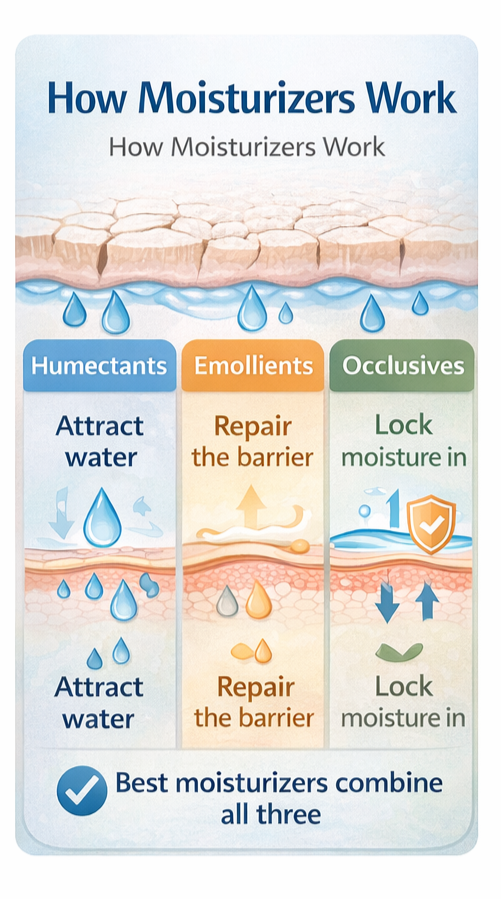
1. Humectants-They Pull Water Into Skin
These ingredients attract water from the environment and deeper skin layers.
Without humectants, skin feels tight very quickly.
2. Emollients-They Repair the Skin Barrier
These smooth out cracks between skin cells and improve softness.
Without emollients, moisture escapes easily.
3. Occlusives–They Lock Everything In
These form a protective layer that prevents water loss.
Without occlusives, hydration does not last.
As a pharmacist, I always recommend moisturizers that combine all three.
Best Moisturizing Ingredients for Dry Skin (Clinically Proven)
Now let’s discuss the most trusted, scientifically proven ingredients-the ones dermatologists and pharmacists rely on.
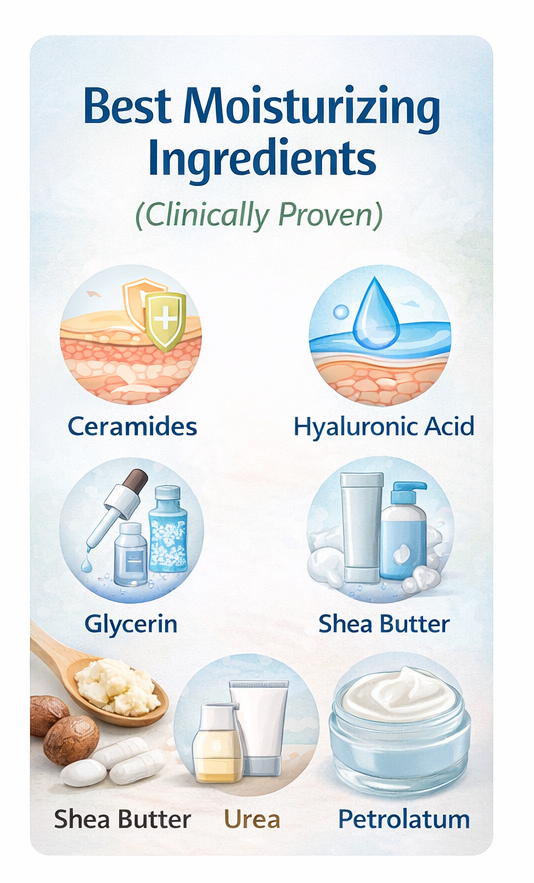
1. Ceramides-The Skin Barrier Repair Ingredient
Ceramides are naturally present fats in healthy skin. When your skin becomes dry, irritated, or sensitive, ceramide levels reduce.
In my pharmacy practice, I often recommend ceramide-based moisturizers to patients with chronic dryness or eczema.
Why ceramides work:
- Repair damaged skin barrier
- Reduce water loss
- Improve long-term skin health
Best for:
✔ Very dry skin
✔ Sensitive skin
✔ Eczema-prone skin
✔ Daily long-term use
Pharmacist tip: Ceramides are safe for both children and adults.
2. Hyaluronic Acid–Hydration That Skin Loves
Hyaluronic acid is famous because it can hold up to 1000 times its weight in water.
Many people apply hyaluronic acid serum and complain that dryness worsens. This happens due to incorrect use.
Benefits:
- Deep hydration
- Improves skin plumpness
- Reduces dryness-related fine lines
Best for:
✔ Dehydrated skin
✔ Dry + aging skin
✔ All skin types
Important advice:
Always apply hyaluronic acid on slightly damp skin and seal it with a moisturizer.
3. Glycerin-Old but Gold (Pharmacist Favourite)
Glycerin is one of the most reliable and safest moisturizing ingredients ever studied.
In fact, many medical moisturizers prescribed in hospitals contain glycerin.
Why glycerin is excellent:
- Draws water deep into skin
- Works even in dry climates
- Extremely gentle
Best for:
✔ Extremely dry skin
✔ Babies & elderly skin
✔ Daily use
Truth: Simple glycerin-based creams often work better than expensive products.
4. Shea Butter–Natural, Yet Scientifically Proven
Shea butter is not just a traditional ingredient-it has real clinical backing.
Benefits:
- Rich in fatty acids
- Repairs rough and flaky skin
- Reduces inflammation
Best for:
✔ Body dryness
✔ Winter skincare
✔ Elbows, knees, feet
As a pharmacist, I often suggest shea butter creams for body care rather than oily face skin.
5. Urea–Medical-Grade Moisturizer
Urea is commonly used in dermatology prescriptions.
Many people get scared seeing “urea” on labels, but it is naturally present in healthy skin.
Benefits:
- Strong moisture attraction
- Softens thick, hard skin
- Improves absorption of other ingredients
Strength matters:
- 5–10% urea: Moisturizing
- 20–40% urea: Skin softening (medical use)
Best for:
✔ Cracked heels
✔ Severe dryness
✔ Diabetic dry skin
High-strength urea should be used only with medical advice.
6. Niacinamide (Vitamin B3)–Skin Strength Builder
Niacinamide works slowly but effectively.
Benefits:
- Strengthens skin barrier
- Reduces redness and irritation
- Prevents moisture loss
Best for:
✔ Dry + sensitive skin
✔ Damaged skin barrier
It suits Indian skin very well and is usually non-irritating.
7. Petrolatum–Most Proven Moisture Lock
Petrolatum has decades of clinical research behind it.
Despite many myths, it is safe, non-toxic, and dermatologist-approved.
Benefits:
- Reduces moisture loss by up to 30%
- Protects damaged skin
- Promotes healing
Best for:
✔ Extremely dry skin
✔ Night use
✔ Compromised skin
Often used in hospitals for wound care and severe dryness.
Ingredients Dry-Skin People Should Avoid
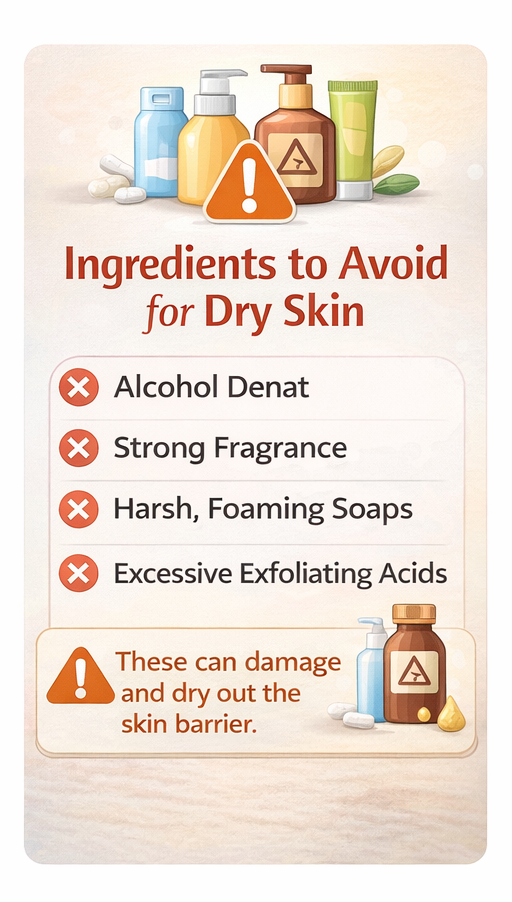
In my daily practice, I see dryness worsen due to:
- Alcohol denat
- Strong fragrance
- Harsh soaps
- Excessive exfoliation
These strip natural oils and damage skin barrier.
How to Choose the Right Moisturizer (Indian Pharmacist Advice)
✔ Check first 5 ingredients
✔ Choose creams over lotions for severe dryness
✔ Use different products for face & body
✔ Adjust according to season
Remember: Price does not equal quality.
Morning vs Night Moisturizing Routine
Morning:
- Light texture
- Non-sticky formula
Night:
- Rich cream
- Occlusive ingredients
- Apply on damp skin
When Should You See a Doctor or Pharmacist?
- Severe itching
- Cracks or bleeding
- No improvement despite regular care
Final Words from a Practicing Pharmacist
As a qualified and practicing pharmacist in India, I want to make one thing very clear-dry skin is not just about beauty or appearance; it is a sign that your skin barrier is unhealthy. When the skin barrier is damaged, it becomes vulnerable to irritation, infections, redness, and long-term sensitivity.
In my daily pharmacy practice, I see many people changing products frequently, following social media trends, or using whatever a friend recommends. Unfortunately, this trial-and-error approach often makes dry skin worse. Skin does not need confusion-it needs consistency and correct ingredients.
The truth is simple:
No moisturizer can work if it does not contain clinically proven ingredients like ceramides, glycerin, urea, hyaluronic acid, and barrier-repair agents.
Expensive brands do not guarantee results-ingredients do.
Regular use of the right moisturizer is far more important than using multiple products occasionally.
Dry skin treatment is not about overnight miracles. It is about repairing the skin barrier slowly and safely, the same way we manage any chronic health condition. With patience, correct product selection, and proper application, most dry skin problems can be controlled effectively.
If your dryness is persistent, itchy, cracked, or painful, do not ignore it. Consult a pharmacist or dermatologist early, because untreated dry skin can lead to eczema, infections, or long-term sensitivity.
Healthy skin is not achieved by trends-it is achieved by science, safety, and consistency.
Frequently Asked Questions (FAQs)
How long does it take for a moisturizer to show results on dry skin?
Most people notice improvement within 7–14 days of regular use. However, full skin barrier repair may take 3–4 weeks, especially in severe dryness.
Can I use the same moisturizer for my face and body?
Not always. Facial skin is thinner and more sensitive. Body moisturizers are usually heavier, while facial creams are lighter and specially balanced.
Is it safe to use moisturizers every day for years?
Yes. Daily long-term use of clinically proven moisturizers is safe and often necessary for people with dry or sensitive skin
Why does my skin still feel dry even after applying moisturizer?
Common reasons include:1.Not using occlusive ingredients 2 Applying on completely dry skin 3.Using harsh cleansers
4.Very dry climate *Tip: Always apply moisturizer on slightly damp skin
Are pharmacy moisturizers better than cosmetic creams?
Pharmacy moisturizers are usually more ingredient-focused, fragrance-free, and clinically tested, making them a better choice for dry and sensitive skin.
Can medicines cause dry skin?
Yes. Some medicines like acne treatments, diuretics, retinoids, and certain allergy medicines can cause or worsen dryness. Always inform your pharmacist or doctor.
When should dry skin be considered a medical problem?
If you experience:
Severe itching
Cracks or bleeding
Red, inflamed patches
No improvement despite regular care
You should consult a dermatologist or pharmacist.
Medical Disclaimer
This content is for educational purposes only and does not replace professional medical advice. Always consult a healthcare professional for persistent skin problems.